← Box #8 Emotional Favourite · BOX #9 WON SALES ANALYSIS · Box #10 Marketing Moat →
How to find and replicate your biggest and best wins.
Analyze Wins, Not Losses
Most founders celebrate a close and move on to the next deal. That is the single biggest missed opportunity in early-stage sales. Analyzing wins tells you what to replicate. Analyzing losses tells you what to avoid — which is far less actionable.
Why are losses less useful? Because you usually lose for the wrong reasons — a price objection that isn’t really about price, “bad timing” that’s really about wrong ICP, “we went with someone else” that hides a relationship gap. Buyers rarely tell you the real reason they didn’t buy. The lessons from losses are systematically misleading. Wins, by contrast, don’t lie: the customer paid, which means everything that drove them to that decision is real and repeatable.
Your winning customers reveal the trigger events, decision windows, emotional motivations, and relationship dynamics that actually drove the sale. Pattern discovery only happens if you document and analyze your wins while memory is fresh — within 72 hours of the close.
Common finding across many founders: “We marketed Feature X, but customers value Feature Y we barely mentioned.” Without Won Sales Analysis, you will never discover this disconnect.
The 5 Post-Close Questions
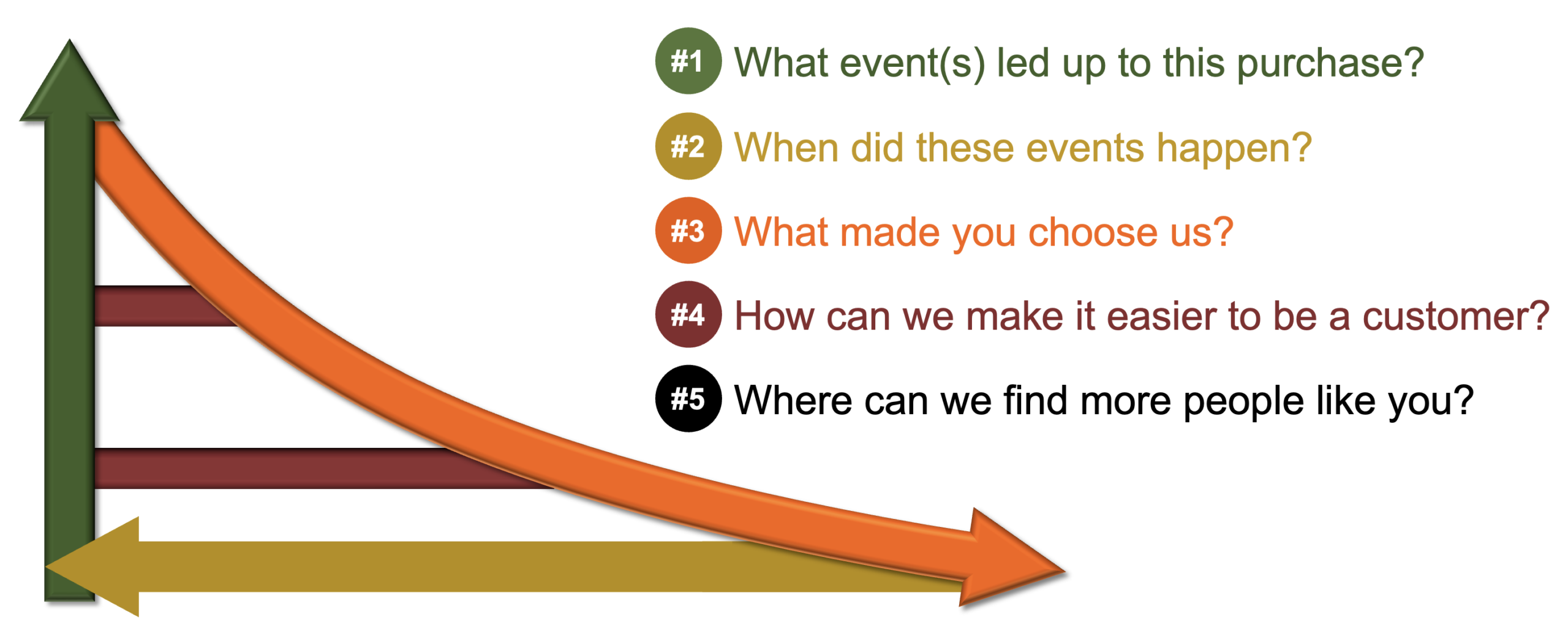
After every customer closes, ask these five questions — within 72 hours while memory is fresh. Ask “what” not “why” — “why” makes people defensive; “what” elicits the verbs and exact words that reveal actual motivations.
What events or changes led up to this purchase?
When did they happen?
What made you choose us?
What can we do to make it easier to become our customer?
Where can we find more people like you?
1. What events or changes led up to this purchase? 2. When did they happen? 3. What made you choose us? 4. What can we do to make it easier to become our customer? 5. Where can we find more people like you?
Finding Repeatable Patterns
After closing your first 3 customers, the real work begins: look across their stories for patterns. Shared trigger events, sales-cycle length, channel of first contact, common objections. These patterns become your repeatable sales playbook — the bridge between founder-led sales and scalable growth.
Step 1 — Document
After closing your first 3 customers, capture each story using the 5 questions. Do it within 72 hours.
Step 2 — Pattern
Look across wins for shared triggers, cycle length, first-contact channel, common objections.
Step 3 — Score
Run each winner through your Box 7 disqualification matrix. Who scored highest, closed fastest, needed least negotiation?
Step 4 — Replicate
Search for the next customer using the exact profile your top closes share. One-page playbook: how you find them, approach them, close them.
Example pattern: all three restaurant managers found you on LinkedIn, had a scheduling failure in the last 30 days, and closed within 2 weeks.
- After closing your first 3 customers, capture each story using the 5 post-close questions. Do this within 72 hours of the close while memory is fresh. Write down the customer’s exact words — do not paraphrase.
- Look for patterns across wins. Shared trigger events, sales-cycle length, channel of first contact, common objections. If all three found you the same way and bought for the same reason, you have your playbook.
- Score each winning customer on your Box 7 disqualification matrix. Which scored highest, closed fastest, had minimal price negotiation, and were willing to be references? These are your ideal profiles to replicate.
- Build your one-page sales playbook. How you find them, how you approach them, the discovery questions that worked, the objections you overcame, average time to close, and the profile of the next customer to pursue.
Validating Your Won Sales Analysis
Three tests to confirm your patterns are real and your playbook is ready.
Test 1: Can You Tell Each Customer's Story in 30 Seconds?
Tim Draper uses this exact test — if a stranger cannot immediately understand the problem and why they bought after 30 seconds, your analysis is not clear enough. Keep distilling until the story lands instantly.
Test 2: Can You Predict Who Your Next Customer Will Be?
Are the patterns across your wins consistent enough to describe your next customer with specificity? If you cannot name the exact person profile, you need more wins to analyze before scaling outreach.
Test 3: Do Customers' Words Match Your Marketing Language?
If your website says "workforce optimization" but every customer says "I wanted my weekends back," your marketing is wrong. The customer's exact words from the 5 questions are your marketing brief.
Third close: Sarah, owner-operator of a 15-person Italian restaurant. Won Sales Analysis conducted 48 hours after signing.
Q1 — What led up to this? "Three servers no-showed on a Friday night. I lost $2,000 in revenue. That was the breaking point." → Friday no-show disaster is a trigger event to listen for.
Q2 — When did it happen? "Three weeks ago. I started looking the next Monday and signed two weeks later." → Outreach window: 2–3 weeks from trigger.
Q3 — What made you choose us? "You responded the same night. The other company took a week." → Response time is the competitive advantage — not features.
Q4 — What would make it easier? "Send the onboarding video before the demo — I'd have signed a week sooner." → Move onboarding video to pre-demo sequence immediately.
Q5 — Where can we find more people like you? "The Independent Restaurants of America Facebook group — I'm in there every day." → New top-priority outreach channel found.
"We marketed Feature X, but customers value Feature Y we barely mentioned. Without Won Sales Analysis, you will never discover this disconnect."
3 Common Mistakes
- Not doing Won Sales Analysis at all. Most founders celebrate the close and move on. Pattern discovery only happens if you document and analyze while memory is fresh — within 72 hours of the close, ideally. Instead, ask the 5 Won Sales Analysis questions within 72 hours of close — the pattern only shows up if you document while memory is fresh.
- Assuming you know why they bought. Your pitch was about eliminating scheduling conflicts. But the customer bought because they wanted their weekends back. If you do not ask, you will never discover the disconnect — and you will keep pitching the wrong thing to the next 100 prospects. Instead, ask “What made you choose us?” — never assume, and write down the customer’s exact words for marketing.
- Not asking what they would tell a friend who has the same problem. The sentence a customer would use to refer you is the most valuable artifact in your entire marketing motion — and you only get it by asking. This is Q5, and most founders skip it or bury it at the end. It often contains the exact 2–3 word phrase that becomes your Marketing Moat. Instead, ask “What would you tell a friend who has the same problem?” — that exact sentence becomes the fuel for Box 10, where word of mouth (2× stronger than every form of paid advertising combined) builds your moat.
What’s Next
Download the fillable Traction Canvas template and run the 5 post-close questions on your next win within 72 hours.
Work on Box #10 — Marketing Moat. Won Sales Analysis gives you the pattern — Marketing Moat scales it. Your customers’ exact words become word-of-mouth fuel that is 2× stronger than every form of paid advertising combined.
← Box #8 Emotional Favourite · BOX #9 WON SALES ANALYSIS · Box #10 Marketing Moat →