“
How to differentiate yourself from the three forms of competition every startup has.
”Master this box and investors see a big market — and you win on the cost of the problem, not a feature war.
Work top to bottom:Start→Do the work→You’re ready
START HERE
“We don’t really have any competition.”
You say it proudly to an investor — and the room goes cold. “No competition” tells investors your market is small. In truth you always have competition — and naming it the right way is how you win.
→ Name what your buyer is already paying to solve this problem.
DO THE WORK
Ask “What” is my competition, not “Who.”
Every startup faces three forms of competition — the alternatives your buyer is already paying for. Name all three, then compete on the cost of the problem:
DIRECT
The nearest rival selling the same thing you do.
Strategy: Avoid.
MOST COMMONLY USED
The everyday alternative most people default to — often a spreadsheet or manual workaround.
Strategy: Be different, not better.
MOST EXPENSIVE
The premium, highest-priced option in the category.
Strategy: Be cheaper.
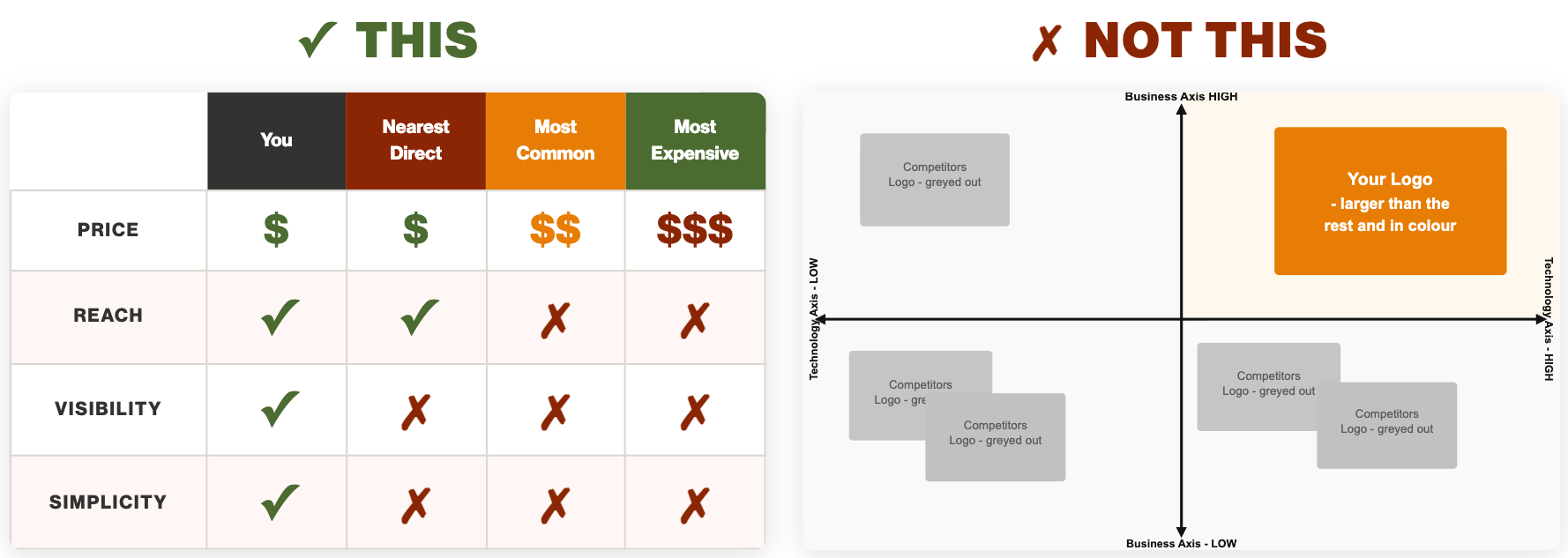
The test: if your solution costs less than the problem does, you win.
Doing nothing is NOT your competition. If a prospect isn’t already spending time, money, effort, energy or resources on this problem, there’s nothing to displace. Until a trigger event makes it urgent, move on — and spend your time with buyers who are already paying to solve the problem you solve.
The #1 thing investors care about is market size. Southwest didn’t compete with airlines — they competed with trains, cars and buses, reframing the category. Julie Angus won two $100K pitch competitions in two days by comparing her ocean drone not to other drones but to the $18,000/day research ships solving the same problem.
“Ask ‘What’ is my competition — not ‘Who’ are my competitors.”
YOU’RE READY
You can name what the problem costs — and show your solution costs less.
When you compete on the cost of the problem instead of a feature checklist, you’ve mastered Competition. Move on to the Seven Second Sale.
THE THREE BIGGEST MISTAKES
SKIP
You claim you “have no competition,” which blinds you to the alternatives your buyer is already paying for.
SHORTCUT
You underestimate the everyday alternative, so you beat the named rival and still lose the market to a spreadsheet.
STUMBLE
You compete on features against rivals — the “who” — instead of pricing against the cost of the problem — the “what” — and end up in a race to the bottom.