How to get meetings with your ICP before you build anything related to your product.

Ask for Advice, Not Money

Traditional sales approaches fail for early-stage founders because you don’t yet know enough about your customer to pitch effectively. The rule is ask for advice, not money. Learn before you earn. Telling is not selling.

Enrolling is a customer conversation framework developed by Professor Heidi Neck at Babson College that replaces traditional cold outreach with requests for advice. Instead of pitching for a sale, you ask people for their perspective on a problem.

This works because it is non-threatening, positions you as genuinely curious, and gives the other person the status of expert. People are hardwired to help when asked for advice — the request is small (20 minutes), there is no sales pressure, and being asked triggers reciprocity. That is why the response rate reaches 70%.

When done well, many enrolling conversations naturally convert to sales conversations — because the person discovers they have the problem and wants your help.

It generates a 70% response rate and is ideal for founders who feel “allergic to sales.” Your goal is 10–20 conversations — and 27 stranger interviews before you move on.

The 27-Stranger Rule

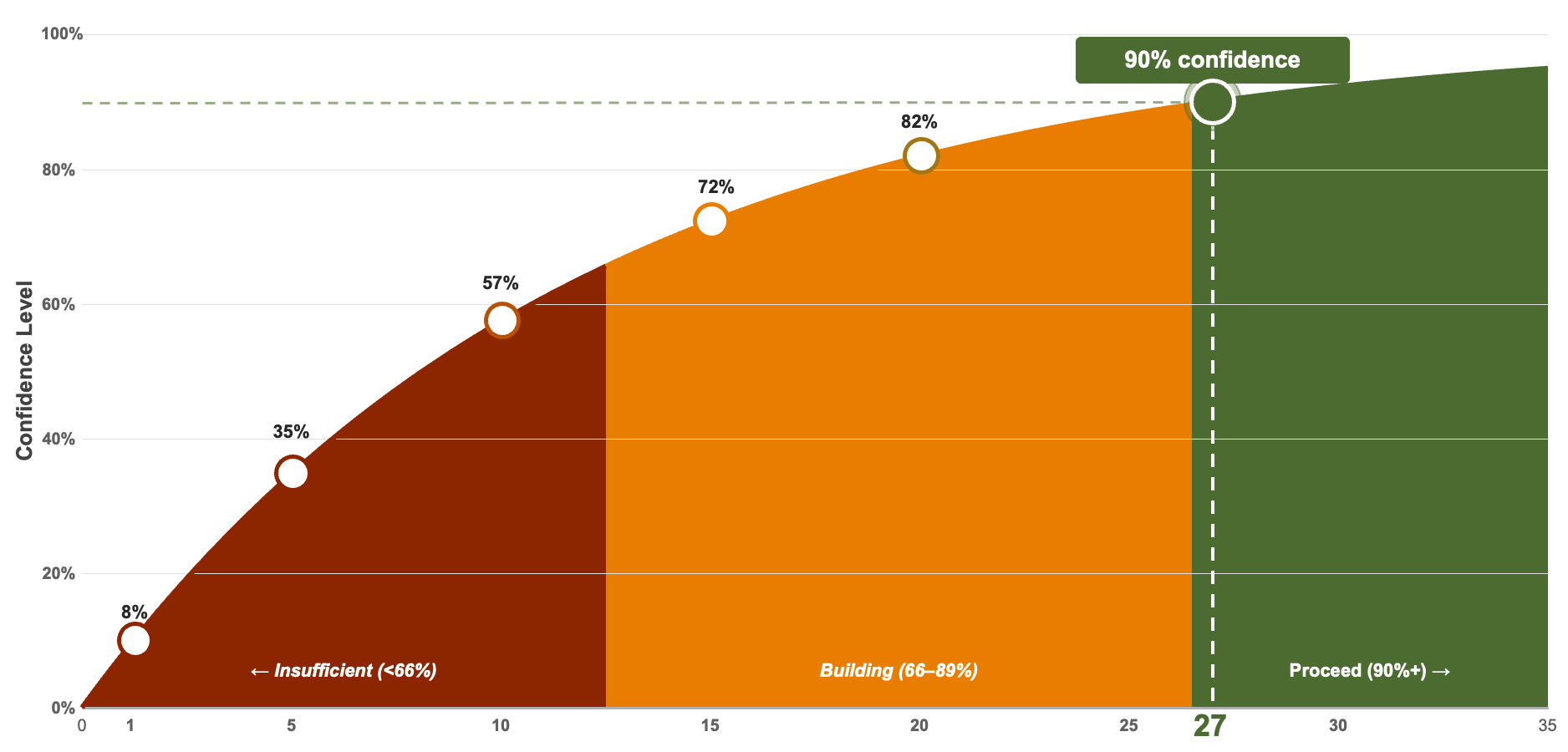
You need 27 stranger interviews to reach 90% confidence in your conclusions. Fewer give correspondingly less confidence — and your gut alone (1 interview) is the most biased data point you have.

1 interview
8%
5 interviews
35%
10 interviews
57%
15 interviews
72%
20 interviews
82%
27 interviews
90% ✓
The Enrolling Message Template

"Hi [Name], I'm reaching out because I'm hoping you have 20 minutes to share your perspective on how we're trying to help [audience] [solve problem].

What do you think?"

The Enrolling Process

Running example: restaurant scheduling software for managers of non-chain restaurants.

  1. Start in your own backyard. Start with those who match your ICP who live or work within an hour’s drive of where you live, so you can go meet them in person.
  2. Send the enrolling message to 5–10 people. Frame the ask as advice, not a sale.
  3. When they meet with you, use your Seven Second Sale (Box 4) as context. When they ask “How?” — don’t answer. Instead ask three discovery questions: How big is this problem for you? How often does it happen? What do you think causes it?
  4. Listen for emotional language, value verbs, and the specific words they use to describe their pain. These words become your sales language.
  5. Reframe if needed: “Would you be willing to give me 5 minutes to help you understand what the real problem might be and how you could solve it?”
  6. After 5–10 conversations, analyze for patterns. Do they all mention the same problem? The same current solution? Is it as urgent as you thought?

Handle the Say-Do Gap

People's stated intentions don't match their behavior. People say one thing, do something totally different.

  • Ask about past behavior, not future intentions. "What did you do last time this happened?" is more reliable than "Would you buy this?"
  • Use "What" and "How" questions — never "Why" questions. "Why" makes people defensive.
  • Listen for verbs and value language — those are the real signals.

During each conversation, also ask: "On a scale of 1–10, how satisfied are you with how you currently handle this?" Research shows people need a 3-point satisfaction drop (e.g., 7 → 4) to actually switch from their current solution. Prospects scoring 7 or below are in or near the Window of Dissatisfaction.

The Three Discovery Questions

When your ICP asks “How?” — don’t answer. Instead, redirect with three discovery questions designed to surface the real pain:

  1. How big is this problem for you? — reveals the cost in time, money, or emotional energy.
  2. How often does it happen? — reveals frequency and whether it’s tolerable or urgent.
  3. What do you think causes it? — reveals their mental model of the problem (which often differs from yours).

Listen for the exact words they use. Their language becomes your marketing language — “I’m drowning in text messages about shift swaps” beats anything you’d write yourself.

Validate Your Enrolling

Three tests to know when you've actually heard enough to act.

Test 1: 27 Stranger Interviews

Have you completed 27 interviews with strangers — not friends, family, or people obligated to be nice? 27 = 90% confidence. Fewer leaves you guessing.

Test 2: Hearing the Same Patterns

Are you hearing the same problem and same current solution from most people? If patterns are not emerging by the time you're well into the 27, your ICP may be too broad — go back to Box 2 and bifurcate further.

Test 3: Customer's Exact Words

Can you describe the problem in your customer's exact words, not your own? If you're still using your own language instead of theirs, you have not listened carefully enough.

Worked Example

Back to PrepPilot — the shift-prediction app for independent restaurants. Here's one enrolling conversation with Sarah, a manager of a 14-seat neighbourhood bistro.

Message sent — "Hi Sarah, I'd love 20 minutes of your perspective on how restaurant managers deal with scheduling headaches. What do you think?"

She agreed. When we met, she asked "what is this for?" — we didn't pitch. Instead we asked the three discovery questions.

How big? — "I'm drowning in text messages about shift swaps."

How often? — "Three nights a week, minimum. Last Friday I lost an hour replying to one server."

What causes it? — "No shared schedule. Everyone texts me directly because it's faster than logging into the system we have."

Satisfaction (1–10) — She rated her current tool at 4. Three-point gap from where she'd switch — she's already in the Window of Dissatisfaction.

Language captured — "drowning in text messages" goes straight into the next message we send and into the homepage headline.

"Ask for advice, not money. Learn before you earn."

3 Common Mistakes

  • Pitching for a sale instead of asking for advice. The moment you start selling, you stop learning. Your job is to understand, not to convince. Resist every urge to explain what you do — this is the single biggest mistake founders make in these conversations. Instead, ask for advice, not money — the conversation that doesn’t feel like a sale is the one that turns into one.
  • Interviewing friends, family, or people who feel obligated to be nice to you. This is “The Mom Test” problem — your mom will always say your idea is great. Biased sources give you false confidence and waste the only window you have to discover truth. Instead, interview 27 strangers — 27 conversations = 90% confidence in the pattern.
  • Stopping too early and asking the wrong question. Five conversations aren’t enough to see patterns — push to at least 27 before drawing conclusions. And “Why did you choose that tool?” makes people defensive; “What made you start using that?” reveals real motivations. Instead, ask “What made you start using that?” — the magic question that reveals the real trigger event and the language they actually use, which becomes the raw material for Box 6, where you learn to reach prospects in the 2–3 week window when they’re 5× more likely to buy.

What’s Next

Download the fillable Traction Canvas template and send your first enrolling message today.

Work on Box #6 — Trigger Events. Learn how to reach prospects in the 2–3 week window when they’re 5× more likely to buy — and the ABC model that categorizes every trigger event you need to monitor.

Box #4 Seven Second Sale · BOX #5 ENROLLING · Box #6 Trigger Events